October 19, 2026 | Orlando, Florida | Day 1 coverage
Artificial intelligence has become a strategic priority for businesses. But after years of investment and experimentation, the more demanding question is no longer whether companies can adopt AI. It is what has actually improved because of it.
That question shaped the opening day of Gartner IT Symposium/Xpo 2026 in Orlando. More than 7,500 CIOs and IT executives are attending the October 19 to 22 event, which brings together technology leaders to explore AI, cybersecurity, business transformation and the evolving role of IT. Under this year's theme, Ignite Intelligence, the focus is increasingly on connecting human judgment with the capabilities of AI.
Insi is joining these conversations on-site and bringing its own research to the stage, alongside client Gerdau, to explore why only a small group of organizations is translating AI investment into lasting business value. This article will be updated throughout the event.
Day 1 | October 19: From AI momentum to measurable outcomes
Gartner's opening keynote: Building AI value faster than risk
At 10 AM, Gartner analysts Daryl Plummer and Kristin Moyer opened the conference with Shaping Momentum: Compounding Value and Risk for the Next Success Horizon. Their message set the tone for the week: AI can create extraordinary momentum, but organizations need to make sure its value compounds faster than its risks.
According to Gartner's keynote analysis, only one in five AI use cases delivers positive returns, while 86% of CIOs in a Gartner poll reported that AI risk was growing faster than AI value in their organizations. The challenge is not a shortage of use cases. It is turning isolated successes into capabilities that continue to generate results across the enterprise.
To explain that challenge, Plummer and Moyer introduced the Gartner Value-Risk Flywheel. The idea is that value and risk are interconnected. New applications, data and agents can multiply the benefits of AI, but they can also amplify errors, security exposure and operational complexity.
A particularly relevant point was the distinction between useful and harmful friction. Strong access controls, human accountability, cybersecurity and spending discipline may slow an individual action, but they protect the organization's ability to grow safely. Unnecessary approvals, duplicated work and fragmented systems create friction without adding protection. For CIOs, the goal is not simply greater speed. It is better momentum.
The keynote also presented the concept of an AI Central Bank: a coordinated approach to governance, technology, economics and intelligence across business functions. It is not about centralizing every decision in IT. It is about giving people and increasingly autonomous systems a consistent framework for making decisions, taking action and remaining accountable.
Insi on stage: What the 8% of AI leaders do differently
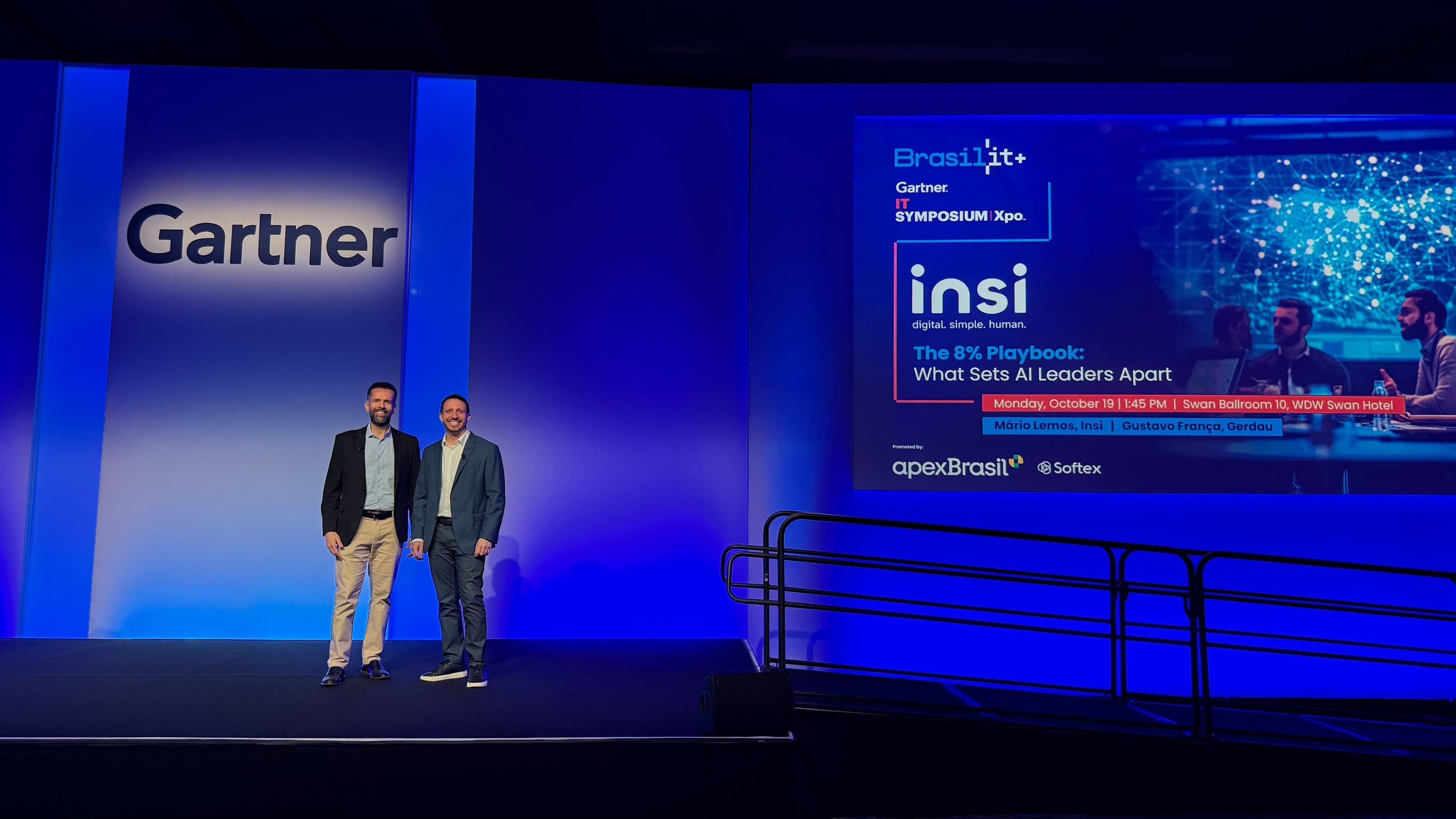
The same gap between adoption and value was at the center of Insi's featured session, The 8% Playbook: What Sets AI Leaders Apart. At 1:45 PM, Mario Lemos, Chief Product and Innovation Officer at Insi, joined Gustavo França, Global CIO at Gerdau, an Insi client, to connect evidence from research with the reality of enterprise transformation.
The starting point was the DXi study conducted by Insi in partnership with Fundação Dom Cabral. Its 2026 edition surveyed more than 100 executives and business leaders across 19 sectors of the Brazilian economy. The research informed the session's central finding: only 8% of the organizations studied have advanced from experimentation toward AI as an integrated capability capable of creating strategic value. Access to tools is widespread. The organizational ability to turn them into results is not.
Lemos and França explored five patterns that help explain the difference. AI leaders begin with business strategy rather than technology selection. They build AI fluency beyond IT, so employees closest to operational challenges can identify opportunities. They make senior leadership accountable for reinvention. They establish governance around value, risk and costs. And they move beyond efficiency to use AI for process redesign, better customer experiences and business growth.
Gerdau brought a practical dimension to the discussion. França described an approach that connects AI initiatives to the steel company's value chain, develops business-side AI champions and involves leadership in governance. He also discussed the use of AI to interpret complex customer-order information and simplify how customers place orders. The opportunity is not merely to automate a back-office task, but to rethink an experience that matters to the customer.
For Insi, there is an additional principle behind these patterns: intentionality. Before deciding what technology to implement, leaders need clarity about the business they want to build. After execution, they need to establish whether the result has become a lasting capability, rather than a one-off improvement. It all starts inside. It all starts Insi.
The value gap: More use cases are not the same as more results
The broader Gartner agenda reinforced that argument. Findings from its 2027 CIO and Technology Executive Agenda survey show that only 13% of CIOs believe their organizations have achieved significant or transformational AI value.
Gartner's higher-performing group, described as Vanguards, distinguishes itself partly through discipline: defining what success means before scaling a pilot and setting criteria for stopping initiatives that do not deliver value. That requires business leaders to take ownership of outcomes alongside technology teams.
The Gartner and Insi figures come from different research populations and measures and should not be treated as directly comparable. Still, the business question is remarkably consistent: how can companies move from many experiments to repeatable, measurable results?
Agentic AI raises the stakes for governance and integration
As AI evolves from answering questions to executing work, the importance of governance becomes more concrete. Gartner reported that 71% of organizations expect to deploy agentic AI within 12 months, while only 21% have agentic AI governance capabilities in place today.
Agents working across enterprise platforms require reliable business context, well-defined permissions, traceable decisions and oversight. Without those foundations, connecting systems can create new risks instead of removing operational friction. Responsible AI is not a separate workstream added after deployment. It has to be part of how the work is designed.
AI economics and the workforce are becoming boardroom issues
The economics of AI also received attention on day one. Unlike conventional software costs, AI spending can vary with model selection, workflow design, usage and agent autonomy. Gartner found that 51% of CIOs expect AI to increase the total cost of ownership of technology solutions. The relevant question is therefore not how many tokens were consumed or tasks automated, but what each investment contributed to the business.
The same shift applies to people. Only 4% of CIOs in Gartner's research report explicit plans to redesign roles for teams that combine people and AI agents. Yet scaling value will depend on exactly that kind of reinvention: building new skills, redesigning processes and allowing CIOs to coordinate technology innovation across the enterprise rather than trying to own every initiative themselves.
What comes next at Gartner IT Symposium/Xpo 2026
The first day pointed toward a clear conclusion: the next competitive advantage in AI will not come from deploying the largest number of tools. It will come from connecting strategy, technology, governance and people in ways that change business performance and make the next improvement possible.
We will update this article through October 22 with further insights from the conference. Attending Gartner IT Symposium/Xpo? Meet Insi at Booth 913 in Pacific Hall, as part of the Brasil IT+ delegation, and explore how to move from AI experimentation to measurable business outcomes.