07/03/2022
The importance of technology in agriculture
Technological innovations in Brazilian agriculture have become more evident in recent years. The strength of the field, illustrated by Agriculture 1.0 (less productive due to the very low use of technology in agriculture), evolved into Agriculture 2.0 (with the implementation of agricultural machinery in rural work).
Today, Agriculture 3.0—marked by the use of technology applied to remote sensing and satellite traceability of production—is moving toward its next phase with the use of data in agricultural production. An important step for the evolution of the entire sector.
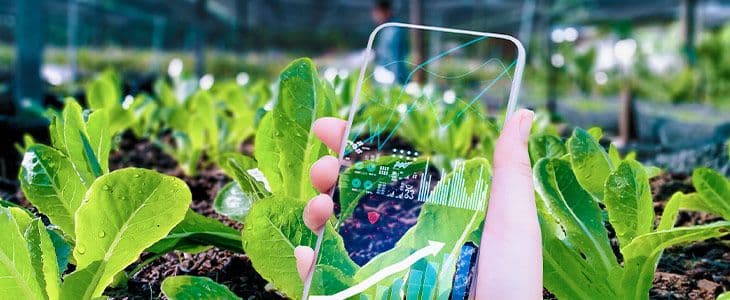
We are now witnessing the emergence of a model already recognized as 4.0, or digital agriculture, in which food production and other agricultural activities use data analysis to develop precision agriculture (in real time), capable of further optimizing the resources offered by the land.
Due to innovative and modern technological resources applied to cultivation, agricultural operations tend to improve their productivity. Among other benefits, agricultural technology also enables crop expansion, which in turn generates potential for development and profitability for agricultural producers. For these and other reasons, a new digital transformation in agribusiness is emerging from now on.
In Agriculture 4.0, data plays an essential role. The implementation of cloud computing and SaaS (Software as a Service) applications makes it possible to accurately process the large volume of information generated by sensors and devices in the fields.
==“The agribusiness sector has long applied technology to increase its production volume. With SaaS solutions, there is a trend toward optimizing data usage. Operations such as production, crop distribution, and commercialization of agricultural products become more transparent and traceable,” says Marcio Flôres, Head of Corporate Venture Capital at Insi (Insi Ventures).==
Among other solutions, in 2021 Insi launched SmartCoop for FecoAgro – RS (Federation of Agricultural Cooperatives of the State of Rio Grande do Sul). This is a business-oriented platform for rural producers; the tool incorporates technologies applied to rural production management and includes three substructures that host and process data while offering services aimed at acquisitions, product commercialization, and input control, to name a few examples.
This is the moment when the digitalization and virtualization of processes define the future of large-scale food production. Agriculture and technology go hand in hand, generating more opportunities and productive growth.
Those who work in agriculture rely on technology
According to the 2017 Agricultural Census by the Brazilian Institute of Geography and Statistics (IBGE), approximately 1.5 million rural producers used data through different electronic devices.
The information reveals the importance and necessity of achieving best practices in data science, especially regarding the information collected by devices and sensors spread across the most diverse crops in the country.
Based on the same study, there is a clear trend of incorporating modern technologies to enable sustainable growth in agricultural businesses. Just as cloud computing solutions] can be scaled, agribusiness continues to adopt technological tools such as artificial intelligence to gain competitiveness and predictability.
In this context, the path leads toward major transformations in the future. Data, agricultural sciences, and business merge to generate more productivity and better job opportunities for cultivation professionals who, at the same time, carry out their activities as technology users.
Types of technology in agriculture
Agricultural technology is advancing rapidly. With the arrival of IoT (Internet of Things) in the field, interesting challenges and new paths emerge to be explored within agriculture. As an emerging topic, IoT is already in an advanced experimental stage for direct application in agribusiness.
Research related to the specific requirements of devices (hardware), advanced wireless communication technologies, and their association with network computing are topics that should be widely analyzed when applying improvements to agricultural cultivation. This is because technology already allows the customization of IT solutions for different crops in agribusiness.
Thus, it is important to highlight that IoT-designed solutions play a fundamental role in collecting crucial information for decision-making in agricultural investments. We are now just a few steps away from experiencing new results from “smart agriculture,” based on cloud services, where all resources can be used to avoid waste, increase market presence, and reach new consumers. In this equation, everyone can benefit.
Recent technologies in rural areas connect data and devices that, together, establish new methodologies and parameters to be applied as scientific knowledge in family farming.
IoT for agriculture and its characteristics
Just as the Internet of Things offers advantages for other industries, it is possible to highlight some main features that can optimize available resources for agribusiness operations:
-
Accessibility: joining a network while compatibility enables the shared ability to consume and produce data.
-
Connectivity: ensuring network accessibility and full compatibility.
-
Heterogeneity: interacting with other devices or service platforms through different networks.
-
Interconnectivity: being able to link with global information and communication between infrastructures.
-
Security: protecting personal data and ensuring physical well-being while performing fieldwork. IoT devices (sensors and cameras, for example) can provide real-time health information about agricultural machinery operators, making it available online.
IoT and Cloud Computing at the service of rural producers
Autonomous information systems based on cloud computing make it possible to efficiently and transparently manage the massive amount of data provided by technologies already present in rural environments.
Customizable SaaS (Software as a Service) solutions are the foundation for the development of Agriculture 4.0. This, in turn, will define a new segment of development in solutions and technologies for establishing the Agriculture as a Service (AaaS) model. In this agricultural production system, big data processing technologies in the cloud drive the growth of solutions that deliver optimized services to improve the Quality of Service (QoS) parameters applied to cultivation.
Collaboration for implementing cloud in agribusiness
The dynamism of the digital business world is much more accessible to rural producers. Therefore, it is worth understanding in depth how this new scenario contributes to their development.
== “The Software as a Service (SaaS) solutions are available for a wide range of markets and segments. Financial and retail sectors have already benefited and recognize the advantages of SaaS. In a short time, agribusiness will advance in incorporating this service into its business strategies and operations,” says Marcio Flôres.==
To implement effective solutions that integrate with IoT devices available on agricultural production properties, small, medium, and large producers must rely on expert technology teams.
Insi has qualified professionals to evaluate and determine the best way to transform the operations and business strategies of any agribusiness company.
Contact our team of specialists!
We create SaaS solutions together for your growth!