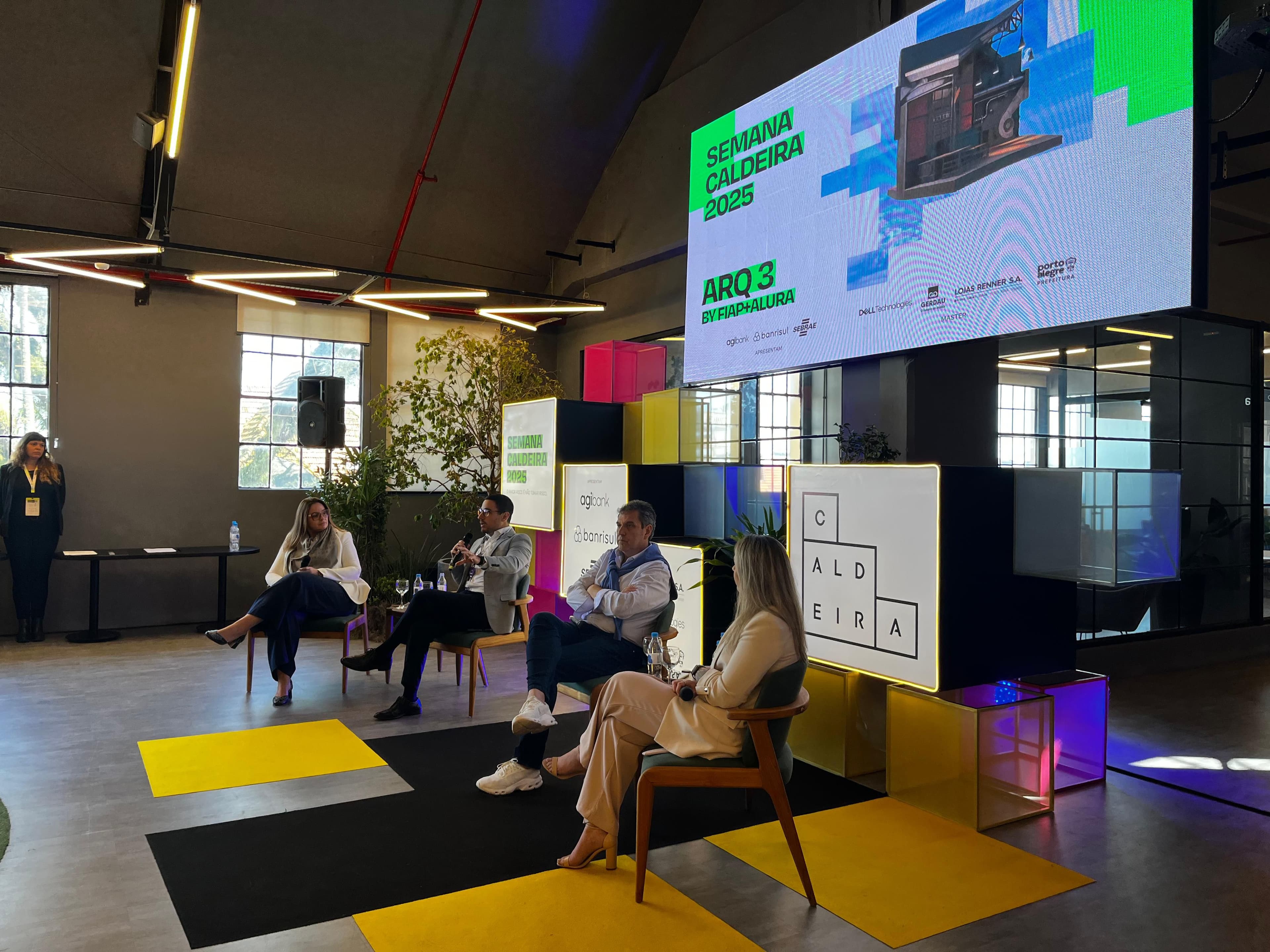
Caldeira Week – 09/29
Caldeira Week is an annual innovation event that brings together leaders, entrepreneurs, and experts to discuss technology, culture, and the future of business. The program takes place at the Caldeira Institute, an innovation hub in Porto Alegre that connects companies, startups, and the community to drive technology and new business ventures.
It was in this setting that the panel “The Future of People Leadership: Talent and Culture at the Heart of Strategy” took place, featuring Daniele Schmidt (CHRO of Sicredi), Katiuscia Teixeira (CHRO of Zenvia), Guilherme Neves (Evermonte), and Cláudio Carrara, co-founder and vice president of Insi. The conversation offered deep reflections on how to lead in a context of accelerated digital transformation, where artificial intelligence and new generations of professionals are changing the rules of the game.
Throughout the debate, it became evident that technology is no longer just a support but a structuring element of how we work. Artificial intelligence, in particular, permeates processes, decisions, and relationships. It requires leaders to move beyond merely delegating tasks and take on a more strategic role, capable of creating growth pathways, taking risks, and guiding increasingly autonomous teams. ==As Cláudio Carrara highlighted, every company will be a technology company and, at the same time, a school, and every leader will have to be, above all, an educator, capable of developing people with purpose and autonomy.==
Another central point was the balance between performance and mental health. These are not opposites but dimensions that go hand in hand when there is psychological safety, clear agreements, and space for honest conversations. Examples brought by Daniele Schmidt from Sicredi showed how simple rituals, such as regular feedback cycles, can increase engagement, trust, and even financial results.
The debate also highlighted the importance of frankness in leadership. Being direct about expectations and responsibilities saves energy and avoids unnecessary misunderstandings. Carrara noted that if he could go back, he would have invested even more in clarity in relationships. At the same time, he emphasized that when lack of performance is widespread, the problem lies not with the teams but with the leadership, in its ability to develop people, make tough decisions, and align culture and strategy.
The new generations also emerged as an important challenge. Many young people do not wish to take on leadership roles within the pressure and demand models inherited from the past. To engage them, it is necessary to offer more balanced development paths, clear purpose, and environments that encourage experimentation and learning. The leader of the future, therefore, will need to reconcile different generational expectations with the need to deliver results in an increasingly competitive market.
The panel concluded with a consensus: ==leading in the era of artificial intelligence means placing people and culture at the center of strategies, without compromising on clarity, empathetic listening, and business vision==. More than ever, leading is about educating, inspiring, and sustaining strong cultures capable of forming diverse and high-performance teams, prepared for the challenges ahead.