At their first joint event in the country, the companies presented the opportunities of the partnership, the Qwen family of models and the paths to turn artificial intelligence into business value.
Insi and Alibaba Cloud brought together clients and partners in São Paulo on November 18 to discuss how the combination of cloud infrastructure, artificial intelligence models and business knowledge can accelerate the transformation of Brazilian companies.
During the event, Eric Secco, Country Manager Brazil at Alibaba Cloud, highlighted Insi as the company's first major partner in the country, underscoring the importance of the alliance in bringing Alibaba Cloud's technologies closer to the needs of the Brazilian market.
The partnership combines Insi's 36 years of experience in understanding its clients' processes, data and challenges with Alibaba's global cloud and artificial intelligence portfolio.
The program presented Insi's new brand and operating model, the expansion of Alibaba Cloud in Brazil, the possibilities of the Qwen family of models and a discussion on the challenges of bringing AI agents into company operations.
Alibaba Cloud expands its presence in Brazil with local infrastructure
Alibaba Cloud, the cloud computing and artificial intelligence division of Alibaba Group, has been expanding its international presence and strengthening its operations in Latin America. One of the main milestones of this expansion was the launch of its first cloud region in Brazil, announced on August 27, 2026. Located in São Paulo and made up of two data centers, the infrastructure expands the offering of computing, storage, networking, database and data analytics services for Brazilian companies.
The arrival of a local operation is a step forward for organizations that want to modernize their technology environments and adopt artificial intelligence at scale, considering performance, availability and governance requirements.
During the event, Eric Secco also shared the company's expansion strategy and highlighted the role of the partner ecosystem in this movement.
In this context, Insi acts as a partner that connects Alibaba Cloud's technological capabilities to the needs of each organization, taking into account their processes, existing systems and business goals.
Qwen: meet Alibaba Cloud's artificial intelligence models
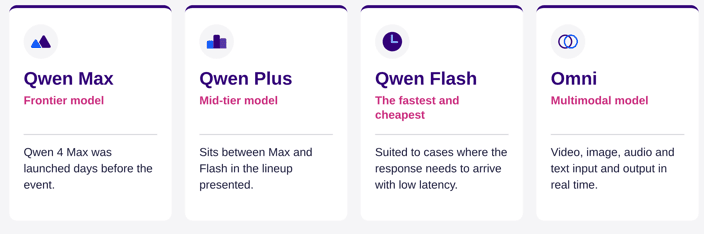
One of the highlights of the event was the presentation of Qwen, a family of artificial intelligence models developed by Alibaba that brings together different capabilities for enterprise applications.
According to the figures presented by Eric Secco, the Qwen ecosystem already has more than 460 open models and exceeds 300,000 derivative models, showing the growth of its development community.
Derivative models are adaptations of existing models that can be specialized for particular languages, industries or tasks. This flexibility makes it possible to evaluate solutions better aligned with the needs of different business processes.
The Qwen portfolio covers applications such as text generation and analysis, programming, document processing and the interpretation of multimodal information.
Model Studio: different AI models on a single platform
To make it easier to build enterprise applications, Alibaba Cloud offers Model Studio, a platform that provides access to AI models through APIs, including the Qwen family and third-party solutions.
The platform makes it possible to explore different approaches to artificial intelligence applications, including techniques such as:
• RAG (Retrieval-Augmented Generation): connects AI models to knowledge bases and documents to generate answers grounded in relevant information.
• Fine-tuning: adapts models to specific tasks through additional training with selected data.
• Integration via APIs: makes it possible to embed AI capabilities into the systems and processes that companies already use.
These possibilities help organizations develop applications without necessarily building or training an artificial intelligence model from scratch.
Another point discussed was the importance of data governance. Alibaba Cloud states that it does not use its customers' enterprise data to develop or improve models without explicit consent. Even so, the location of processing, storage and the services used should be assessed according to the architecture and requirements of each project.
The cost of AI goes beyond the price per token
Choosing an artificial intelligence model should not rest on its usage price alone. Quality of responses, processing speed, the need for human review and integration costs also affect the viability of an application.
For this reason, one of the concepts highlighted during the event was the cost per completed task, an indicator that makes it possible to assess the investment needed to reach a given result, taking into account the solution's actual performance.
In the live demonstration, the CoWork tool, presented by Alibaba Cloud, used public information about Brazilian companies to produce, in a few minutes, a comparison spreadsheet and an executive presentation.
The example showed how the combination of AI models and integrated tools can support research, analysis and information organization.
AI agents in practice: the challenge of turning pilots into operations
Beyond presenting the technologies, the event made room to discuss one of the main challenges of artificial intelligence in companies: how to move from experimentation to applications integrated into the business.
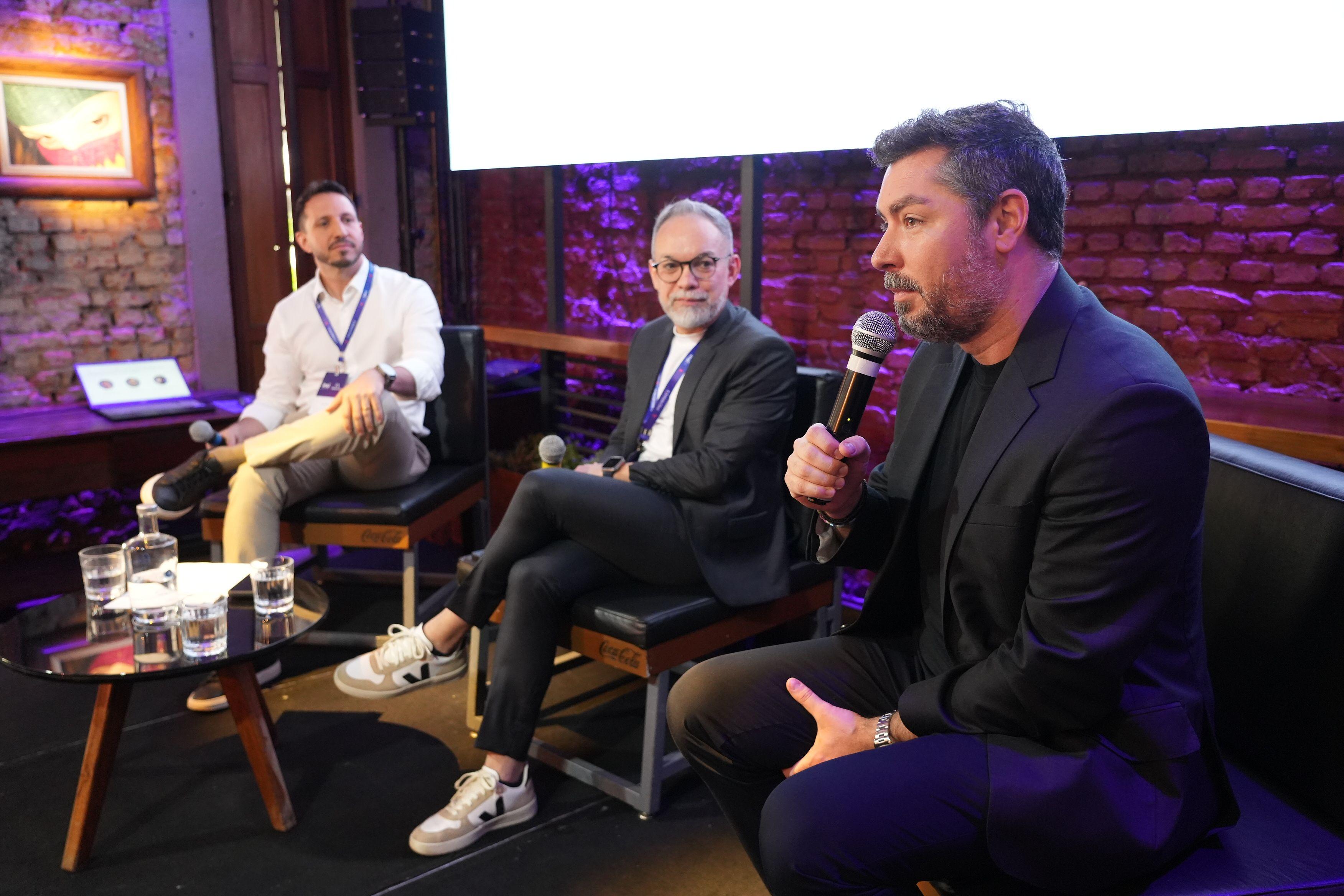
The discussion was the subject of the panel “AI agents in practice: how new technologies are changing the way business operates,” with Eric Secco, from Alibaba Cloud, and Flavio Ribeiro, from Insi.
The debate brought reflections on model selection, cloud strategies, scalability and the factors that need to be considered for AI initiatives to move beyond proofs of concept.
This discussion also connects to the results of Insi DXi, a study developed by Insi in partnership with Fundação Dom Cabral (FDC). The survey shows that only 8% of companies manage to extract strategic value from artificial intelligence.
The finding reinforces that access to technology, by itself, does not guarantee results. It is necessary to understand business goals, identify relevant opportunities and establish criteria to assess the benefits of each initiative.
Among the central points of this journey are integration with enterprise systems, choosing the most suitable models, data governance and the ability to track quality, costs and results over time.
More than adopting a new technology, the challenge lies in making it part of the operation, in a sustainable way and aligned with the organization's priorities.
Insi and Alibaba Cloud: from model selection to business application
With the partnership, Insi and Alibaba Cloud expand the possibilities for companies that want to evaluate new artificial intelligence models, modernize their infrastructure and develop applications connected to existing processes.
This journey can begin with identifying a use case, followed by evaluating the models, the economic viability and the integration and security requirements.
From that analysis, it is possible to validate solutions with representative data, prepare their move into production and track indicators of quality, adoption and cost per task.
The proposal is to let each company choose the technologies best suited to its context, without assuming the replacement of all its existing infrastructure.
Want to find out how Qwen models and Alibaba Cloud solutions can support your company's challenges?
Talk to the Insi and Alibaba Cloud specialists and explore the possibilities of applying artificial intelligence to your processes, with a strategy aligned to the needs of your business.